ORVI
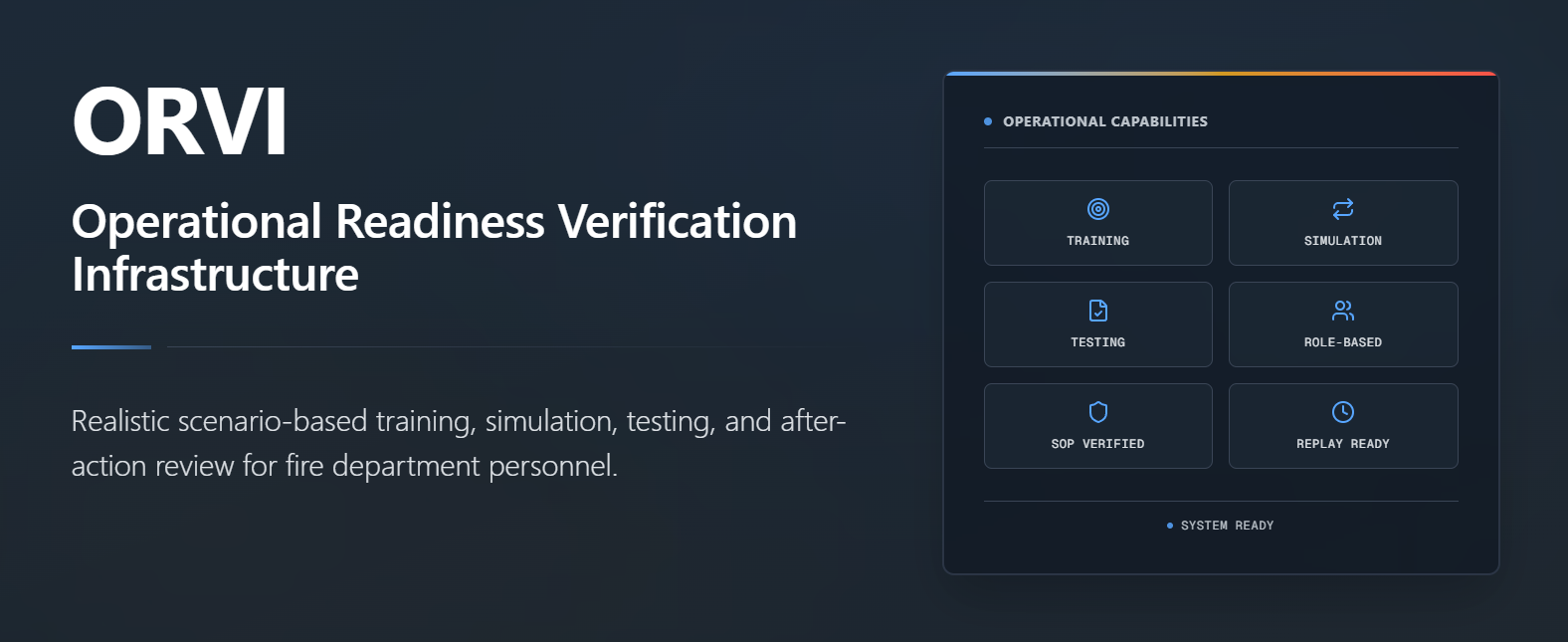
Operational readiness verification infrastructure with deterministic scenario execution and measurable behavioral performance.
The Problem
Traditional fire department training systems primarily verify course completion, certifications, and participation hours rather than actual operational readiness. Personnel may complete required training but still struggle to execute correct decisions, maintain sequence discipline, establish command quickly, or follow operational doctrine under real incident pressure. Most systems measure what firefighters know — not whether they can reliably perform under evolving emergency conditions where timing, escalation, and decision quality directly impact outcomes.

The System
The system creates doctrine-driven emergency scenarios that evolve dynamically based on operator actions, timing, and incident conditions. Role-specific evaluations verify procedural execution, command establishment, escalation behavior, tactical prioritization, and timing compliance under realistic operational pressure. Every decision, action, deviation, and response window is captured within a replayable operational trace for after-action review, readiness validation, and defensible performance verification.
How It Works
INPUT → LOGIC → EXECUTION → OUTPUT
INPUT → LOGIC → EXECUTION → OUTPUT Department SOPs, operational doctrine, role responsibilities, and incident conditions are converted into deterministic behavioral rules and timing requirements. Logic governs scenario progression, branching conditions, escalation triggers, and operational constraints. Execution evaluates real-time actions, sequence integrity, command behavior, and timing performance under pressure. Output produces replayable operational evidence, readiness verification reports, doctrine compliance analysis, performance scoring, and identified operational gaps.
What It Governs
How operational readiness is verified through deterministic scenario execution, doctrine enforcement, timing validation, and measurable behavioral performance under realistic emergency conditions.
System Definition Coverage
Inputs
Department SOPs, operational doctrine, role responsibilities, incident variables, dispatch information, environmental conditions, resource availability, and scenario escalation factors.
Constraints
Deterministic operational sequencing, timing requirements, escalation rules, role-based responsibilities, branching conditions, and protocol compliance continuously enforced throughout execution.
Decision Logic
Scenario progression governed by operator actions, timing compliance, tactical decisions, escalation behavior, environmental changes, and doctrine-based operational rules.
State & Flow
Scenario initialization → dispatch → mobilization → arrival → size-up → command establishment → tactical prioritization → escalation evaluation → operational progression → readiness evaluation → after-action replay.
Outputs
Replayable operational timelines, readiness verification reports, decision traces, timing compliance metrics, doctrine deviation analysis, performance scoring, escalation reviews, and operational gap identification.
Validation
Operational sequencing, timing discipline, command establishment, escalation correctness, tactical prioritization, procedural adherence, and readiness reliability validated through deterministic evaluation logic.
Result
Verified operational readiness through measurable behavioral execution, deterministic doctrine enforcement, replayable operational evidence, and defensible readiness validation beyond traditional training completion systems.
Past Builds
Explore more projects from our studio.